
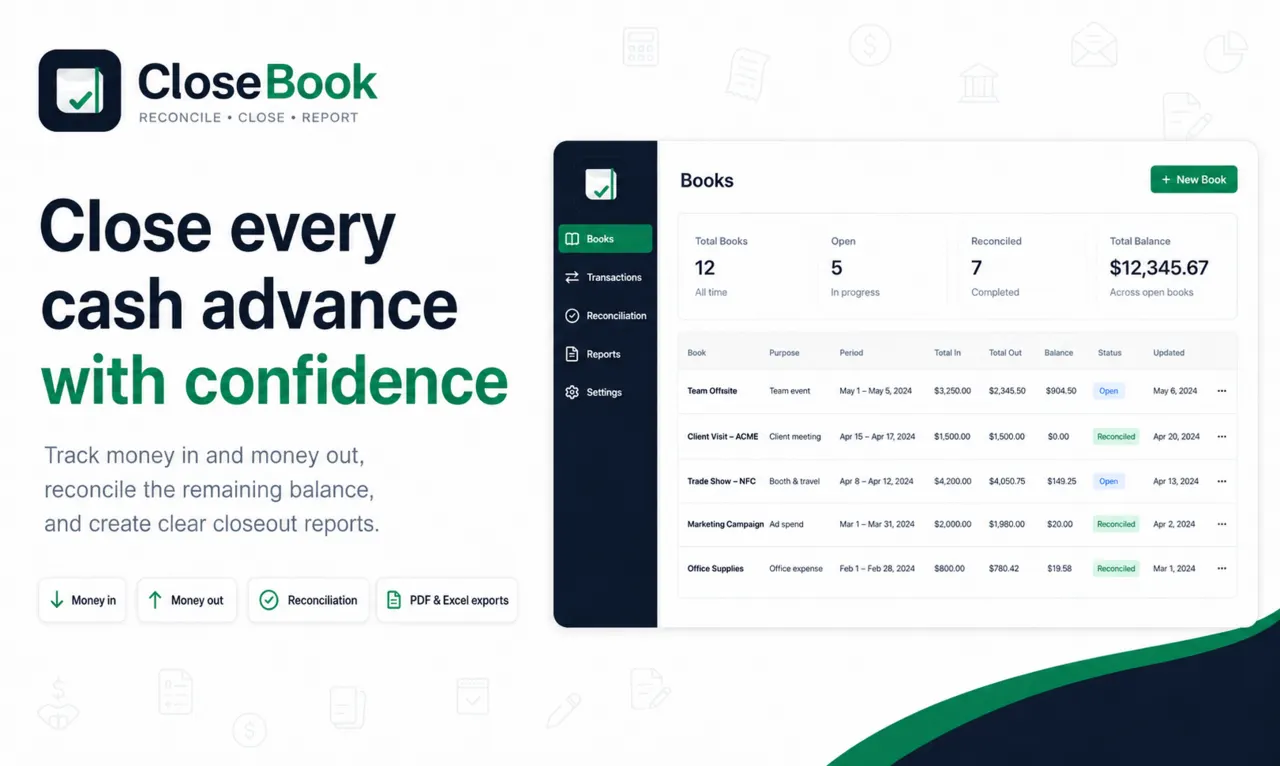
A visible cash advance reconciliation template
A useful template should connect the source of funds, the transaction register and the final cash count. The fields below mirror the information needed for a practical closeout rather than a generic expense list.
| Section | Field | Purpose |
|---|---|---|
| Book information | Title, reference, responsible person, currency | Identifies the temporary fund and who is accountable for the record. |
| Funds | Starting balance and additional money in | Shows all money available to the book. |
| Transactions | Date, type, description, category, documentation, amount | Creates the evidence-based transaction register. |
| Reconciliation | Expected balance, actual balance, difference | Compares the calculated balance with the amount actually remaining. |
| Closeout | Difference explanation, status, dates, signatures | Documents the result and completes the record. |
Completed template example
Worked example
Reconciliation result
The expected balance is $1,500.00 + $200.00 − $1,320.00 = $380.00. The actual cash is $365.00, so the difference is $365.00 − $380.00 = −$15.00. The closeout should explain the shortage and record any corrective action required by the organization.
How to use each field correctly
Starting balance
Use this for cash already on hand when the book starts. Funds received later should be recorded as Money In so the transaction history remains clear.
Money In and Money Out
Money In increases the available funds. Money Out records payments and expenses. Do not enter refunds, top-ups or returned cash in a way that hides the direction of the movement.
Documentation
Record an invoice number when available. When documentation is unavailable, use a documented exception and state what happened. An exception does not prove that an expense is acceptable; it makes the missing evidence visible for review.
Actual balance at close
Enter the amount counted or confirmed at the time of close. It should not be copied from the expected balance unless the cash was actually counted.
Common template mistakes
- Changing the starting balance after later funding is received.
- Combining several unrelated advances in one book.
- Recording expenses without dates, categories or documentation status.
- Entering the expected balance as the actual balance without counting cash.
- Closing with a shortage or surplus but no explanation.
- Treating the template as a replacement for organizational approval rules.
Closeout checklist
- All funds received are recorded.
- Every expense has a valid amount and description.
- Expense categories are complete.
- Each expense has an invoice number or documented exception.
- The remaining cash has been counted.
- Any shortage or surplus is explained.
- The report and audit trail have been exported or retained as required.