
What cash advance reconciliation means
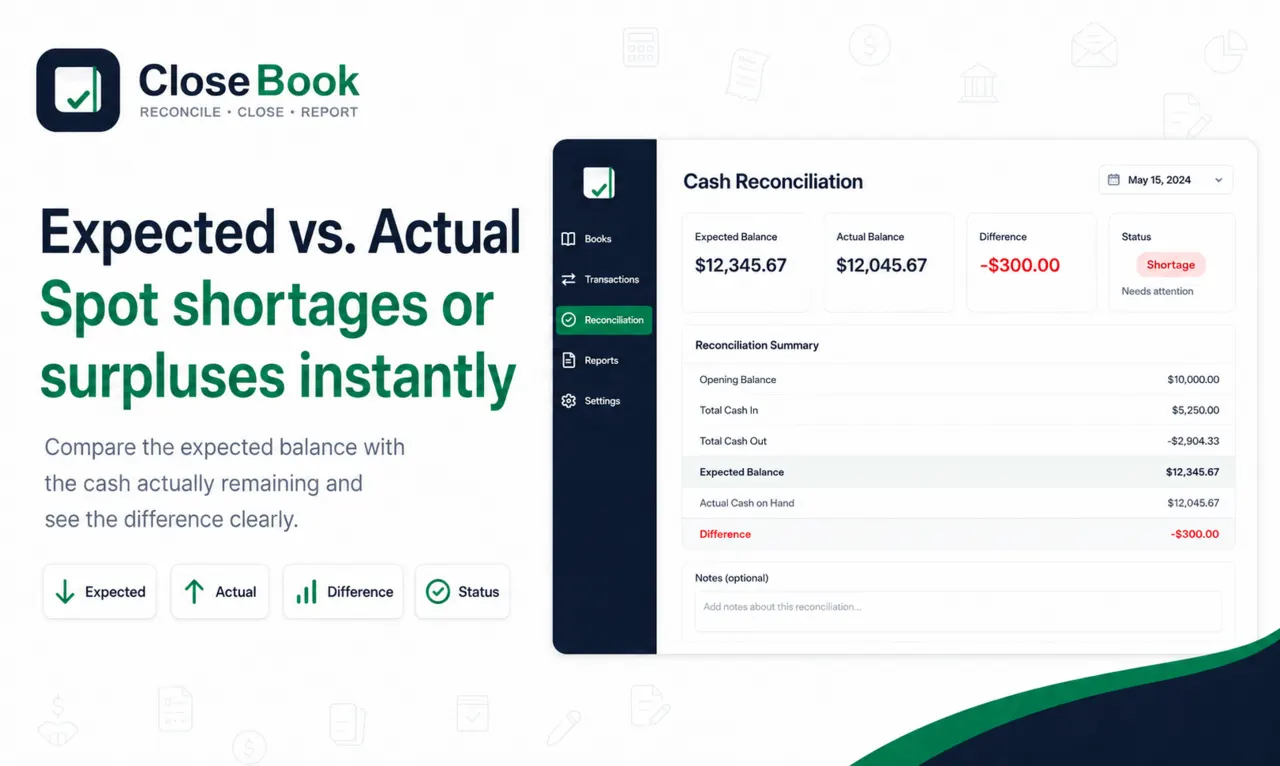
Cash advance reconciliation is the process of proving what happened to temporary funds after they were issued for a specific task, project, purchase, field activity or event. The record should show the amount available, the expenses paid, the cash still on hand and any difference between the expected and actual balance.
CloseBook is designed for this closeout workflow. It is not a full accounting system and it is not positioned as a household expense tracker. It helps the person responsible for temporary funds create a structured record that can be reviewed, explained and exported.
Why expense tracking alone is not enough
A list of expenses answers only one question: what was spent? Reconciliation also asks what should remain, what actually remains and why those amounts differ. Without that comparison, an expense list can look complete while still leaving an unexplained shortage, surplus or unrecorded cash movement.
The practical reconciliation workflow
Create one book for one temporary fund
Name the project, task, activity or purchase and identify the responsible person. Keeping one purpose per book makes the closeout easier to review.
Record all funds received
Enter the starting balance and add later funding as Money In. Do not record later funding by changing the starting balance.
Record expenses and supporting details
Add each Money Out transaction with a date, description, category and invoice number or documented exception.
Review the transaction register
Check for missing categories, invalid amounts and incomplete documentation before counting the remaining cash.
Count the actual cash remaining
Enter the amount physically on hand or otherwise confirmed at close.
Explain and close
Document a shortage or surplus when the difference is not zero, then close the book and export the report.
Shortage, surplus and balanced outcomes
| Outcome | Calculation | Meaning |
|---|---|---|
| Balanced | Actual − Expected = $0.00 | The counted cash matches the recorded balance. |
| Shortage | Actual − Expected is negative | The actual cash is lower than the recorded expected balance. |
| Surplus | Actual − Expected is positive | The actual cash is higher than the recorded expected balance. |
When CloseBook is a good fit
- A procurement officer receives an advance to buy specific items.
- A field officer manages funds for a site visit or field activity.
- An event coordinator receives a temporary event budget.
- A project coordinator needs to settle travel, transport or activity expenses.
- A freelancer manages client-provided funds for a defined task.
- A small organization needs a consistent closeout report and audit trail.
What the closeout report should make clear
A useful report identifies the book, responsible person, dates, currency, funds received, expenses, expected balance, actual balance, difference, explanation, transactions and sign-off fields. CloseBook also retains an audit trail of important book actions.